
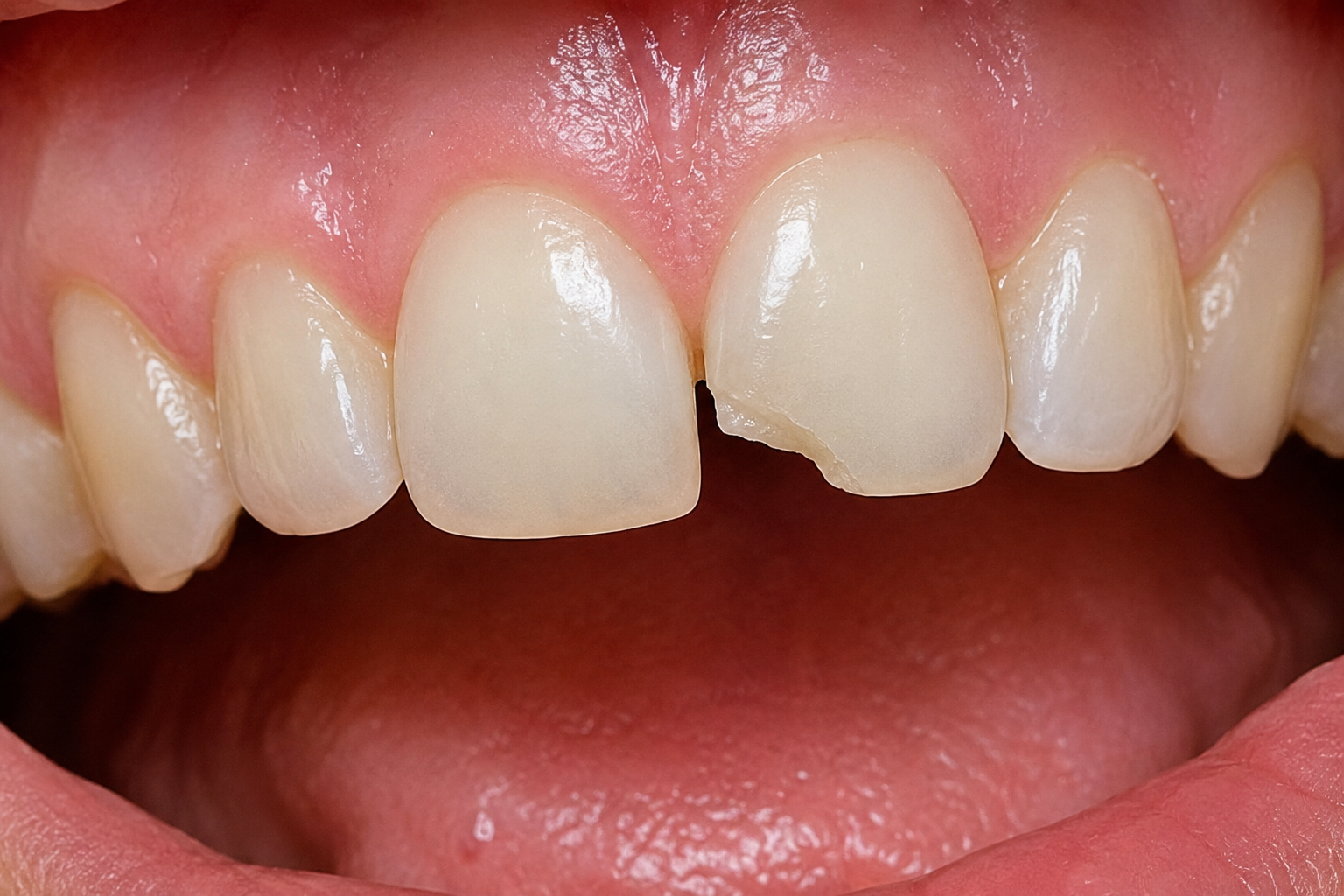
A tooth can chip or break in a surprisingly ordinary moment. You might bite into something hard, fall, take a knock during sport or simply notice that part of a tooth has broken while eating. Sometimes there is immediate pain. Other times, you only realise something is wrong when your tongue catches on a sharp edge.
The first thing to know is that a broken or chipped tooth does not always mean the tooth has to be removed. A small chip may be repaired fairly simply, while a deeper fracture can involve the inner part of the tooth and require more extensive treatment. The appearance of the damage can also be misleading. A tooth may look like it has only lost a small piece on the outside while a crack extends further underneath.
What you do immediately afterwards can also make a difference. If you have found a piece of the tooth, keep it rather than throwing it away. Avoid chewing on the damaged side and arrange a dental assessment, particularly if the tooth is painful, sensitive or has broken significantly.
The right treatment depends on what has actually happened to the tooth. A dentist may recommend bonding or another restoration for a small chip, while a larger fracture may require a filling, crown or root canal treatment. In some cases, the damage may be too extensive to restore and extraction may need to be considered.
The important thing is not to panic, but also not to assume that a broken tooth can simply be ignored because the pain is mild.
Request an Assessment for a Broken or Chipped Tooth
Fill in the form below to tell the Laomai Medical Centre team what happened and request an appointment to have the damaged tooth assessed.
What Should You Do Immediately After Breaking a Tooth?
Your first reaction may be to keep touching the damaged area with your tongue to work out how much of the tooth has broken. Try not to do that repeatedly. A newly damaged tooth can have a sharp edge, and constantly rubbing your tongue or cheek against it can make the surrounding tissues sore.
If you can find the piece of tooth that has broken off, keep it. Place it in a clean container and, if possible, keep it moist with milk or saliva rather than allowing it to dry out. Although the dentist may not always be able to reattach the fragment, having it available can sometimes be useful when assessing the damage and discussing possible treatment.
Rinse your mouth gently with water to clear away small pieces of tooth or food. If there is bleeding, apply gentle pressure with clean gauze or a clean cloth. Avoid repeatedly rinsing forcefully or poking around the damaged tooth to see how loose it is.
For the moment, choose softer foods and chew on the opposite side of your mouth. This is particularly important if a large section of the tooth has broken away, because the remaining structure may be weaker than it looks.
Then arrange a dental assessment. Even if the tooth is not particularly painful, a dentist can determine how far the damage extends and whether the tooth needs to be repaired.
What If You Find the Broken Piece of Tooth?
Do not throw it away.
Place the fragment in a clean container and take it with you when you see the dentist. Keeping it moist can be preferable to allowing it to dry out completely. Milk is commonly recommended for transporting a tooth fragment, although the dentist will ultimately determine whether the fragment is suitable for use.
There is no guarantee that the broken piece can simply be glued back onto the tooth. The fragment may be too small, damaged or unsuitable for reattachment. Even so, bringing it along gives the dentist the opportunity to examine it.
In some cases, the dentist may be able to use the fragment as part of the repair. In others, a tooth-coloured restorative material may provide a better result.
The important thing is to preserve the fragment rather than assuming that it is useless.
Does a Chipped Tooth Always Need Treatment?
Not necessarily.
A very small chip that affects only the outer enamel may not require extensive treatment, particularly if there is no pain, sensitivity or other problem. However, it is still worth having the tooth checked rather than deciding for yourself that the damage is insignificant.
The reason is that a chip can sometimes be associated with a larger weakness or crack that is not immediately obvious. A dentist can assess the tooth and determine whether the damage is purely cosmetic or whether it has affected the tooth’s structure.
A small chip may sometimes be smoothed or repaired with tooth-coloured material. If the damage is more substantial, a different restoration may be more appropriate.
There is also the question of why the tooth broke in the first place. A healthy tooth does not usually lose a significant section without some kind of force, weakness or underlying problem. If the tooth was already heavily filled, weakened by decay or previously damaged, the fracture may be telling you something about the tooth’s condition.
How Can You Tell How Serious a Broken Tooth Is?
You cannot always tell from the size of the missing piece.
A small-looking fracture can sometimes extend deeper into the tooth, while a relatively dramatic chip may only involve the outer enamel and dentine.
Pain and sensitivity can provide clues, but they are not enough to diagnose the extent of the damage.
If the tooth is sensitive to hot or cold, hurts when you bite down or has started aching after the injury, the inner tissues may have been affected. A visible crack, bleeding from the tooth itself or a large section of missing tooth structure also warrants prompt attention.
A dentist will look at the damaged area and may use dental X-rays or other diagnostic methods when necessary. This helps determine whether the damage is limited to the visible part of the tooth or extends further into the structure.
What If the Broken Tooth Does Not Hurt?
This is one of the easiest situations to dismiss.
You may break a piece of tooth while eating, look in the mirror and realise that it has chipped, but feel completely normal. Because there is no pain, you might decide that there is no urgency and simply leave it alone.
A lack of pain is reassuring, but it does not prove that the tooth is fine.
Some fractures cause immediate sensitivity or pain, while others do not. A tooth can also have structural damage without producing obvious symptoms at first.
The broken edge may also make the tooth more vulnerable to further wear or another fracture. If the damage has exposed a rough or weakened area, normal chewing forces may eventually make the problem worse.
That does not mean every painless chip requires emergency treatment. It does mean that a dental assessment is sensible, particularly if the chip is more than a tiny cosmetic defect or the tooth had already been damaged before it broke.
What If the Tooth Is Sensitive After It Breaks?
Sensitivity after a fracture is worth taking seriously.
You may notice a sharp sensation when drinking something cold, eating something hot or breathing in cold air. Some people experience sensitivity only for a moment, while others develop a lingering ache after exposure to temperature.
The reason for the sensitivity matters.
If the fracture has exposed deeper layers of the tooth, the area may become much more sensitive than it was before. If the damage is closer to the pulp, the living tissue inside the tooth may also have been irritated.
This does not automatically mean that you need a root canal.
The dentist needs to assess the tooth and determine whether the pulp is healthy, inflamed or damaged. Depending on the findings, treatment may range from a relatively simple restoration to more extensive treatment.
If you have developed new sensitivity after breaking a tooth, do not deliberately keep exposing it to hot and cold foods to “test” it. That can make an already irritated tooth uncomfortable without giving you a reliable diagnosis.
What If a Large Piece of the Tooth Has Broken Off?
A large fracture deserves prompt dental attention even if the tooth is not currently painful.
When a substantial section of a tooth is missing, there may not be enough remaining structure to protect it during normal chewing. The tooth may also have a fracture extending further than you can see.
You may notice a large hollow area, a sharp edge or a tooth that suddenly looks much shorter than the one next to it.
Try not to bite on that tooth until it has been assessed. Something as ordinary as biting into a sandwich or a piece of meat can place considerable pressure on the remaining structure.
The dentist will assess how much healthy tooth remains and whether it can be rebuilt.
Depending on the situation, treatment could involve a filling or restoration, bonding, a crown or another approach designed to protect the remaining tooth.
What If the Tooth Broke Around an Old Filling?
This is a fairly common situation, particularly with teeth that have already had substantial dental work.
A tooth with a large filling may have less natural tooth structure remaining than an untouched tooth. Over time, chewing forces can place stress on the remaining walls of the tooth.
If part of the tooth breaks around an existing filling, the dentist needs to determine whether the problem is limited to the filling or whether the underlying tooth has fractured.
Sometimes the damaged restoration can be replaced.
In other situations, the remaining tooth may need additional protection, particularly if a significant amount of natural structure has been lost.
A crown may sometimes be considered when a tooth is substantially weakened because it can cover and protect the remaining structure. The appropriate treatment depends on how much healthy tooth remains and whether the tooth is otherwise suitable for restoration.
What If You Can See a Crack in the Tooth?
A visible crack should not be ignored simply because the tooth is still attached and functioning.
Some cracks are superficial and limited to the outer tooth structure. Others extend deeper and can become more problematic when the tooth is repeatedly exposed to chewing forces.
You might notice pain when biting down or releasing your bite, sensitivity to temperature or an intermittent ache. However, symptoms vary and the absence of pain does not necessarily tell you how far the crack extends.
Do not try to test the tooth by repeatedly biting hard foods.
A dentist can examine the tooth and determine whether the crack appears superficial or whether there are signs of more significant structural damage.
The sooner a potentially significant crack is assessed, the more information you have about whether the tooth can be protected.
Can a Broken Tooth Be Repaired?
In many cases, yes.
The type of repair depends on how much tooth structure has been lost, where the damage is located and whether the remaining tooth is healthy enough to support a restoration.
A small chip may be repaired with composite material that is matched to the colour of the tooth. This can restore the shape without requiring a large restoration.
A larger fracture may require a more substantial restoration. If a significant amount of the tooth has been lost but the remaining structure is strong enough, a crown may be considered to help protect it.
If the fracture has affected the pulp inside the tooth, root canal treatment may be necessary before the tooth can be restored.
Laomai Medical Centre provides broken and chipped tooth repair as well as dental fillings and restorations, allowing treatment to be matched to the extent of the damage rather than assuming that every broken tooth requires the same procedure.
When Might Bonding Be Enough?
Dental bonding can be useful when a relatively small amount of tooth structure has been lost.
The dentist uses a tooth-coloured restorative material to rebuild the damaged area and improve the shape of the tooth. It can be particularly useful for smaller chips affecting the front teeth, where appearance is an important consideration.
One of the advantages of bonding is that it can often be completed without removing large amounts of healthy tooth structure.
However, bonding is not suitable for every broken tooth.
A large fracture, a heavily weakened tooth or a tooth exposed to substantial chewing forces may require a stronger or more comprehensive restoration.
The decision should be based on both appearance and function. A repair that looks good but cannot withstand the forces placed on the tooth is unlikely to be the right long-term solution.
When Might a Crown Be Needed?
A crown may be considered when a tooth has lost a significant amount of its structure and needs additional protection.
Unlike a small bonding repair, a crown covers the remaining tooth structure and is designed to restore the tooth’s shape and function while protecting what remains.
This can be particularly relevant when a tooth has been weakened by extensive decay, a large filling or a substantial fracture.
However, a crown is not automatically required simply because a tooth has chipped.
If the damage is small, a less extensive restoration may be sufficient. The dentist needs to consider how much healthy structure remains and how much protection the tooth actually requires.
The goal is to use an appropriate restoration rather than automatically choosing the most extensive treatment available.
What If the Broken Tooth Has Exposed the Inside?
A deeper fracture can expose the dentine or, in more severe cases, the pulp inside the tooth.
When the pulp is exposed, the tooth can become extremely sensitive and may require prompt treatment.
You may notice intense sensitivity, pain or an unusual sensation from the damaged area. The exposed tissue can also be vulnerable to contamination from bacteria in the mouth.
This is a situation where you should not wait for the tooth to “settle down” before arranging an assessment.
The dentist will need to determine whether the pulp is still healthy and whether the tooth can be restored. If the nerve has been significantly damaged or infected, root canal treatment may be necessary before the tooth can be rebuilt.
The sooner the tooth is assessed, the sooner you can find out what is realistically possible.
Request a Custom Tooth Repair Quote
Fill in the form below to describe your broken or chipped tooth and request an assessment and personalised treatment estimate.
Can a Broken Tooth Cause an Infection?
It can, particularly when a fracture allows bacteria to reach deeper parts of the tooth.
The outer layers of a tooth provide protection for the pulp inside. When a significant fracture compromises that protection, bacteria can potentially reach areas that are normally sealed away from the mouth.
That does not mean every chipped tooth will become infected.
A small enamel chip is very different from a fracture that extends deeply into the tooth. The risk depends on the nature and extent of the damage and the condition of the tooth before it broke.
Signs such as increasing pain, swelling around the tooth, a bad taste, sensitivity that becomes worse or an unpleasant discharge should be assessed promptly.
If you develop significant facial swelling, difficulty swallowing or difficulty breathing, seek urgent medical attention rather than waiting for a routine dental appointment.
What If the Tooth Was Broken in an Accident?
A tooth damaged during a fall, sporting accident, car accident or blow to the face needs to be considered in the context of the entire injury.
The tooth may not be the only structure affected.
There can be damage to the lips, gums, jaw or neighbouring teeth, even when the most obvious problem is a broken tooth. If the impact was significant, tell the dentist exactly what happened and when it happened.
If the tooth was knocked loose or displaced rather than simply chipped, the situation may require more urgent attention.
Children can also experience dental trauma during play or sport, and a damaged baby tooth can require a different approach from an injured permanent tooth.
Do not assume that an injury is minor simply because the tooth is no longer painful.
What If a Child Chips a Tooth?
A chipped baby tooth and a chipped permanent tooth are not necessarily treated in the same way.
With children, the dentist needs to consider the child’s age, whether the damaged tooth is a baby tooth or permanent tooth and how much of the tooth has been affected.
If the injury occurred during a fall or accident, there may also be damage to other teeth or surrounding tissues.
A child may not be able to describe sensitivity or pain particularly well, so changes in eating, behaviour or reluctance to use one side of the mouth can sometimes be useful clues.
If your child has broken or chipped a tooth, arrange a dental assessment rather than trying to determine the seriousness of the damage at home.
What Should You Avoid After Breaking a Tooth?
Once a tooth has broken, the instinct can be to test it.
You might bite down to see whether it still works, run your tongue over the edge repeatedly or eat something hard to find out whether it hurts.
Try not to.
The remaining tooth structure may be weaker than before, and putting additional force on it can potentially make the fracture worse.
For the same reason, avoid chewing ice, hard sweets, nuts or other very hard foods with the damaged tooth until it has been assessed.
Do not attempt to glue a broken piece back onto the tooth yourself. Household adhesives are not designed for use inside the mouth and can cause additional problems.
If the edge is sharp and is cutting your tongue or cheek, you can protect the area temporarily with dental wax if you have access to it, but this should not replace a dental assessment.
How Quickly Should You See a Dentist?
The appropriate timeframe depends on what happened and what the tooth looks and feels like.
A tiny chip with no pain or sensitivity may not require an emergency appointment, but it is still worth arranging a routine assessment so the dentist can determine whether the tooth needs repair.
A large fracture, significant sensitivity, ongoing pain or a tooth that has been damaged by trauma deserves more prompt attention.
If the tooth is bleeding from the inside, severely painful, loose, displaced or associated with significant swelling, do not delay seeking professional care.
Laomai Medical Centre lists broken teeth among the concerns that may require prompt dental attention through its emergency dental care service.
The key is not to judge urgency solely by how much of the tooth appears to be missing.
A small visible chip can sometimes hide a deeper problem, while a larger-looking chip can occasionally be repaired relatively simply.
When Is a Broken Tooth a Dental Emergency?
Not every broken tooth is an emergency, but some situations should be treated as urgent.
Severe pain is one obvious warning sign, particularly if it is interfering with sleep or normal activities. Significant bleeding, facial swelling or a tooth that has been badly displaced after an injury also needs prompt assessment.
A fracture that exposes the inside of the tooth can also require urgent attention because the deeper tissues are no longer adequately protected.
If you have suffered facial trauma and have symptoms such as loss of consciousness, severe headache, vomiting, difficulty breathing or swallowing, or a suspected jaw injury, the situation goes beyond a dental appointment and may require emergency medical care.
For a straightforward chip without pain, swelling or other concerning symptoms, a routine dental appointment may be appropriate.
The important thing is to match the response to the actual circumstances rather than assuming that every chipped tooth is either harmless or an emergency.
What Will the Dentist Do During the Assessment?
The first step is usually to understand what happened.
The dentist may ask how the tooth broke, whether there was an injury, whether you have experienced pain or sensitivity and whether the tooth had previous dental work.
They will then examine the tooth and surrounding tissues.
Depending on the injury, an X-ray may be recommended to look for problems that are not visible from the outside. This can be particularly useful if the dentist is concerned about a deeper fracture, root damage or an injury involving the supporting structures.
The dentist will then consider what treatment is appropriate.
You may be told that the tooth only needs a small repair. Alternatively, you may need a more substantial restoration or treatment of the tooth’s inner tissues before the final restoration can be placed.
The important part is that the treatment should be based on the actual condition of the tooth.
Can a Dentist Tell If a Tooth Is Too Damaged to Save?
Often, the dentist can make a good assessment of whether a tooth is restorable, although some fractures can be difficult to evaluate immediately.
The amount of healthy tooth remaining is one of the key considerations.
A tooth needs enough sound structure to support whatever restoration is being planned. If the fracture extends too far below the gumline or the root is severely damaged, restoring the tooth may not be predictable.
This is where the distinction between “broken” and “unrestorable” becomes important.
A broken tooth is not automatically a lost tooth.
Many damaged teeth can be repaired. The question is whether there is enough healthy structure left to create a stable, functional result.
If the tooth cannot be predictably restored, the dentist may discuss extraction and what options could be considered afterwards.
What If the Tooth Needs a Root Canal?
A broken tooth does not automatically need root canal treatment.
Root canal treatment may become necessary when the pulp inside the tooth has been significantly damaged or infected. A deep fracture can expose or irritate the pulp, particularly when the damage extends beyond the outer layers.
Symptoms can include prolonged sensitivity, spontaneous pain or discomfort when biting, although symptoms alone cannot determine whether the pulp needs treatment.
If a root canal is recommended, it is generally intended to treat the damaged or infected tissue inside the tooth while allowing the natural tooth to remain in place where possible.
The tooth will then usually require a suitable restoration to protect the remaining structure.
This is why a fracture can sometimes involve more than simply repairing the visible chip.
Could a Broken Tooth Need to Be Extracted?
Sometimes.
Extraction may be considered when the tooth has been damaged so extensively that it cannot be predictably restored.
For example, a severe fracture that extends deeply into the root or a tooth with very little healthy structure remaining may not provide a reliable foundation for restoration.
That does not mean extraction is the first response to a broken tooth.
The dentist will generally consider whether the tooth can be restored and whether doing so has a reasonable chance of providing a useful long-term result.
If extraction is necessary, you can also discuss what happens afterwards. Depending on the tooth, its position and your overall oral health, replacement options may be considered.
Why You Should Not Ignore a Chipped Tooth
A small chip can be easy to forget about, especially when it stops hurting.
You may get used to the slightly rough edge and simply carry on with your normal routine.
But teeth are exposed to chewing forces every day. If a tooth has already lost part of its structure, continuing to use it normally without understanding the extent of the damage may not be ideal.
There is also the possibility that the chip was caused by an underlying weakness rather than being purely accidental.
A dental assessment gives you a chance to find that out while the problem is still manageable.
It may turn out to be a minor repair. It may require more treatment. Either way, knowing what you are dealing with is better than guessing.
What Can You Eat After Breaking a Tooth?
Until you have had the tooth assessed, softer foods are generally easier to manage.
Foods that require heavy chewing or that are particularly hard can put unnecessary pressure on the damaged area.
Try to chew on the opposite side of your mouth and avoid using the broken tooth as a test subject.
If the tooth is sensitive, very hot or cold foods and drinks may trigger discomfort. You can temporarily avoid those triggers while waiting for treatment.
These measures are simply about protecting the tooth until you can have it assessed.
They are not a substitute for repairing a tooth that requires treatment.
How Much Does Broken Tooth Repair Cost?
There is no single price for repairing a broken or chipped tooth because the treatment can range from a small cosmetic repair to a much more involved restoration.
A small chip may require relatively little treatment, while a severely fractured tooth could need a filling, crown or root canal treatment followed by a restoration.
The material used, the amount of tooth structure lost and the treatment required all influence the cost.
If you are concerned about the price, ask the dentist to explain the available treatment options and the expected cost of each appropriate option.
This is particularly useful when there is more than one clinically suitable way to repair the tooth.
Rather than choosing a treatment based solely on the cheapest initial figure, consider what each option is designed to achieve and how well it is likely to protect the remaining tooth.
Can You Prevent a Tooth From Chipping Again?
Once a damaged tooth has been repaired, protecting it becomes important.
Avoiding very hard foods and habits such as biting pens, opening packaging with your teeth or chewing ice can reduce unnecessary stress on your teeth.
If you grind or clench your teeth, tell your dentist. Repeated forces from grinding can place considerable pressure on teeth that have already been weakened.
A custom mouthguard may also be appropriate for people who participate in sports where facial injuries are possible. Laomai Medical Centre provides custom mouthguards designed to protect teeth and the mouth during sport.
Regular dental check-ups can also help identify weakened fillings, decay or other problems before they contribute to another fracture.
The goal is not to become afraid of using your teeth normally. It is to reduce avoidable stresses that can contribute to further damage.
Request Professional Advice About Your Damaged Tooth
Fill in the form below to explain what happened and request expert advice about the most suitable way to repair your broken or chipped tooth.
What If the Chip Is Only Cosmetic?
Not every chipped tooth causes pain or affects the way you chew.
Sometimes the main concern is simply that a front tooth no longer looks the same.
A small chip can change the outline of a tooth enough to be noticeable when you smile, even when the tooth is otherwise healthy.
In these situations, cosmetic bonding may be one option. The dentist can use tooth-coloured material to rebuild the missing section and restore a more natural shape.
The treatment still needs to be based on an examination, however.
A chip that looks cosmetic from the outside may involve more of the tooth than expected, particularly if there is an underlying crack.
It is better to establish that the tooth is structurally sound before treating the appearance alone.
What If the Tooth Feels Sharp After It Breaks?
A sharp edge is common after a tooth chips or fractures.
You may notice it immediately with your tongue, particularly if the damaged tooth is near the front of your mouth.
Try not to keep running your tongue over the edge. The repeated friction can make your tongue sore, and it does not tell you anything useful about how serious the fracture is.
If the edge is cutting your cheek or tongue, mention this when you contact the dental practice.
A dentist may be able to smooth the area or repair the tooth, depending on the nature of the damage.
Do not attempt to file the tooth down yourself. A tooth may appear to have a simple sharp corner, but removing tooth structure without knowing what lies underneath can create a much bigger problem.
Can a Tooth Break Without an Obvious Accident?
Yes.
A tooth can fracture while eating without a dramatic injury.
Sometimes the force is simply the final event affecting a tooth that has already been weakened by decay, a large restoration, repeated stress or previous damage.
This is why the question “What did I bite?” is not always enough to explain why a tooth broke.
If you break a tooth while eating something that is not particularly hard, tell your dentist. They may want to examine the tooth for signs of underlying decay, an old filling that has failed or other structural weakness.
Understanding why the tooth broke can be just as important as repairing the piece that has been lost.
What If You Have Broken the Same Tooth Before?
Repeated fractures are a reason to look beyond the immediate chip.
If the same tooth has broken more than once, there may be a structural issue that needs to be addressed.
Simply repairing the same area repeatedly may not be the best long-term approach if the remaining tooth structure is becoming progressively weaker.
Your dentist may consider whether the tooth needs a stronger restoration or whether another underlying problem is contributing to the repeated damage.
This is particularly relevant when a tooth has a large filling, has previously undergone root canal treatment or has already lost a significant amount of natural structure.
The treatment plan should take the history of the tooth into account, not just the latest fracture.
When Should You Contact a Dentist About a Broken Tooth?
A broken or chipped tooth deserves attention whenever you are unsure how significant the damage is.
Arrange an assessment if the tooth is painful, sensitive, sharp, visibly cracked or missing a substantial piece. You should also seek care if the tooth broke after an accident or if the surrounding gum, cheek or jaw has been injured.
If there is significant swelling, severe pain, uncontrolled bleeding or difficulty breathing or swallowing, seek urgent care.
For a small painless chip, you may not need emergency treatment, but a dental appointment can still determine whether the tooth needs repairing or simply monitoring.
The sooner you understand what has happened, the easier it is to make a sensible decision about the next step.
The Good News About a Broken or Chipped Tooth
Breaking a tooth can look alarming, particularly when the damage is visible every time you smile.
But a broken tooth does not automatically mean that the tooth is beyond repair.
Modern restorative dentistry offers several ways of rebuilding damaged teeth, and the appropriate option depends on how much healthy structure remains and what has happened underneath the visible fracture.
A small chip may need little more than a carefully shaped restoration. A larger fracture may require more protection, while a deeper injury may need treatment of the tooth itself before it can be restored.
The key is getting the tooth assessed rather than trying to judge its condition from appearance alone.
Laomai Medical Centre provides dental assessments, broken and chipped tooth repair, fillings and restorations, crowns and root canal treatment, allowing the treatment approach to be matched to the condition of the tooth.
Broken or Chipped Tooth: What Should You Do Next?
If a piece of your tooth has broken off, keep the fragment if you can, rinse your mouth gently, avoid chewing on the damaged side and arrange a dental assessment.
Do not try to glue the tooth back together yourself, file down sharp edges or repeatedly test the tooth by biting hard foods.
Pay attention to symptoms such as pain, sensitivity, swelling or bleeding, but remember that the absence of symptoms does not always mean the damage is insignificant.
A dentist can determine whether the tooth has a small surface chip, a deeper fracture or damage affecting the inner part of the tooth. From there, you can discuss whether bonding, a filling, a crown, root canal treatment or another form of repair is appropriate.
If the tooth cannot be predictably restored, extraction may be discussed, but a broken tooth should not automatically be treated as a tooth that needs to come out.
The sooner you have a damaged tooth assessed, the sooner you can stop guessing about what happened and start dealing with the actual problem.
Request Your Broken Tooth Assessment
Fill in the form below to request an appointment with Laomai Medical Centre and discuss the best treatment option for your broken or chipped tooth.


